Follow Us :


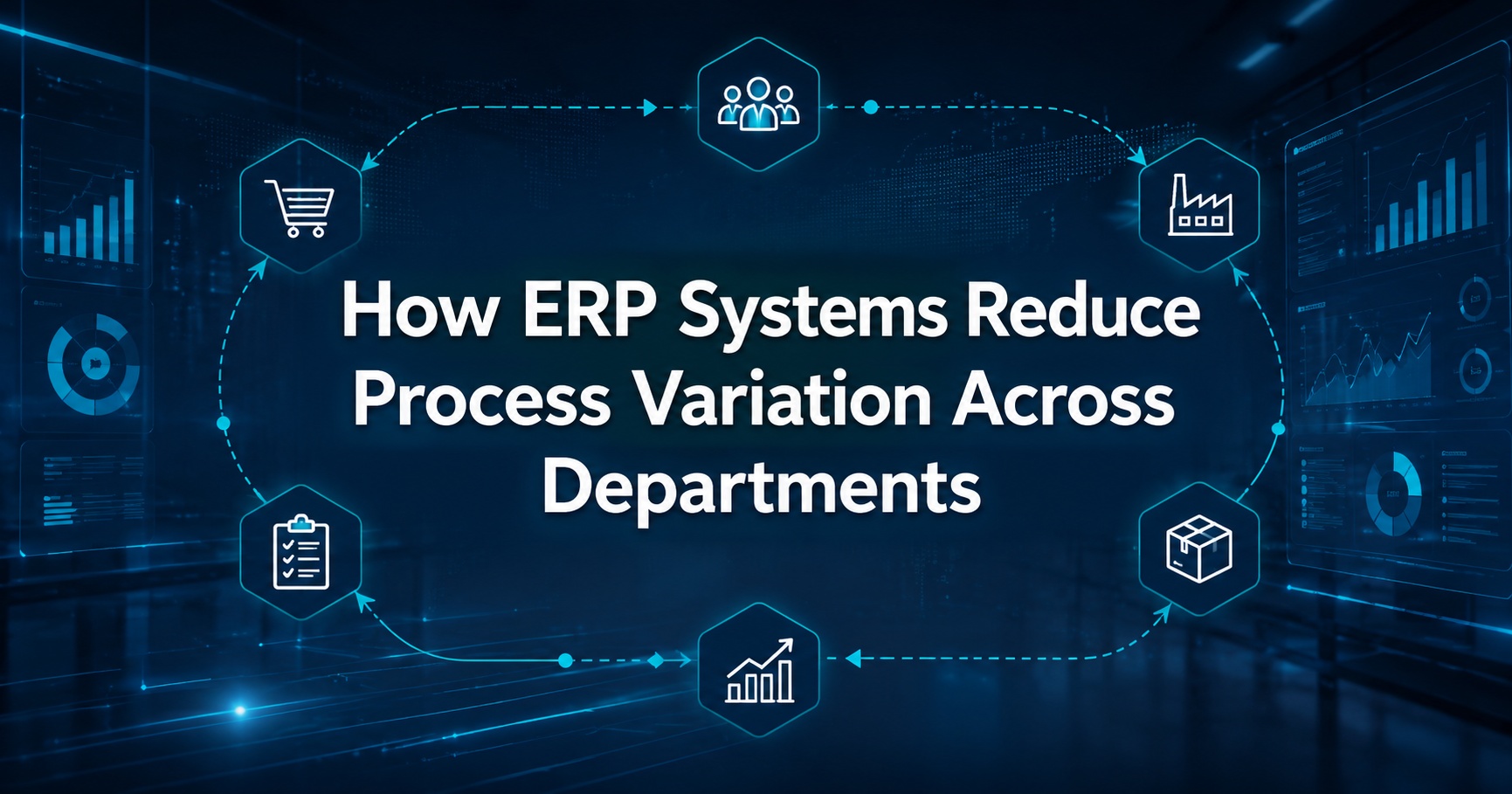
Ask two department heads for the same number and you'll often get two answers. Sales reports revenue one way. Finance reports it another. Both are sure they're right, and technically neither is lying. They're just reading from different systems, using different definitions, built on different spreadsheets.
That gap is process variation. And it quietly costs businesses real money.
When every team runs its own version of a process, errors multiply. Orders get billed at the wrong price. Inventory counts drift from reality. Approvals stall because nobody agrees on who signs off. Reports contradict each other, and leadership makes decisions on numbers that don't hold up. Left alone, this quiet disruption spreads across the supply chain, dragging on productivity at every handoff.
A good ERP system attacks this at the root. Instead of letting each department invent its own way of working, it gives the whole company one shared record and one standard path for each process. This article breaks down how that works, where it delivers the most value, and why it sometimes fails.
Process variation is the difference in how the same task gets done depending on who does it, when, and in which department. Some of it is fine. Some of it is expensive.
Not all variation is bad. A sales team might structure deals differently for a strategic account than for a small one-off customer. That flexibility protects revenue. A rigid system that forces every deal through an identical template can actually push high-value customers away and slow deal velocity.
Avoidable variation is different. It's the same invoice being coded three ways. It's two warehouses using different naming conventions for the same part. It's an approval that takes an hour in one region and a week in another for no good reason. This is the variation worth eliminating.
The skill is telling them apart. Standardize the wrong things and you break what was working. Standardize the right things and you cut errors without cutting flexibility.
You can usually feel the problem before you can measure it:
Variation isn't usually anyone's fault. It grows naturally when systems and incentives pull teams apart.
When sales runs a CRM, finance runs accounting software, and the warehouse runs its own tool, each becomes an island. Data gets re-entered by hand at every border crossing. Each re-entry is a chance to introduce a discrepancy.
Marketing's "conversion" isn't finance's "closed deal." One team counts a customer at first contact, another at first payment. When definitions don't match, neither do the reports built on them.
Spreadsheets are where standardization goes to die. They're private, editable, and invisible to everyone else. Two people maintaining "the same" sheet will drift apart within weeks.
If approval authority lives in people's heads instead of in a system, it changes with mood, workload, and memory. Handoffs between departments then become negotiations rather than routine steps.
An ERP suite reduces variation by removing the conditions that create it. Here's the mechanism, piece by piece.
This is the foundation. ERP systems centralize data storage and management, giving organizations a single source of truth, which eliminates data silos and ensures all departments access consistent, accurate, and up-to-date information. One record. Every department reads and writes to it. There's no "your number vs. my number" because there's only one number.
The payoff is concrete. Because data is entered once rather than multiple times, errors drop and duplication disappears, which improves overall data quality.
The ERP encodes how a process should run. A purchase approval follows the same route whether the CFO or a new hire kicks it off. Every department adheres to the same protocols and procedures, which increases consistency and reduces errors, and also simplifies training and onboarding.
The system enforces rules at the point of entry. Mandatory fields must be completed before a record can be saved, and validation rules ensure data conforms to predefined standards before it is stored. A process can't advance with a blank required field or a value outside company policy. Human discretion, and human error, gets removed from the routine steps.
This is where the silos actually break. An order entered by sales instantly updates available inventory and feeds financial forecasting. No handoff email. No re-keying. The data flows through the process rather than being carried across department lines by hand. Modern ERP systems streamline the entire supply chain this way, so procurement, warehouse, and finance all move on the same signal instead of chasing each other.
Users only touch what they're authorized to touch. Approvals route automatically based on value, department, or item type. In a well-configured SAP Business One procure-to-pay flow, invoices matching preconfigured settings move straight to payment, and exceptions get flagged and sent to designated approvers instead of slipping through.
Everyone sees the same live status. ERP improves reporting accuracy by providing real-time access to integrated data from all departments, so reports reflect the most current and comprehensive information. When the numbers are shared and trusted, meetings stop being about whose data is correct and start being about what to do next.
Every transaction leaves a record: who did what, when, and under which approval. That trail makes bottlenecks visible, supports compliance, and settles disputes with fact instead of memory.
The same central engine shapes each function differently.
Standardized charts of accounts, posting rules, and close procedures mean the books reconcile against operations automatically instead of through month-end heroics.
Requisitions follow one approval hierarchy. Preferred vendors and spending thresholds are built in, so a $500 purchase and a $50,000 purchase take appropriately different but consistent paths.
Shared item codes, bin logic, and transaction rules keep inventory management consistent across locations. This is where SAP Business One is genuinely strong, and where consistent inventory control management pays off fastest, because stock accuracy depends on every warehouse following the same transaction discipline.
Bills of materials, routings, and issue methods are standardized, so the same product costs and consumes the same way on every run.
Quotes, orders, and pricing rules follow defined logic, while still leaving room for the deliberate flexibility that protects big accounts.
Standardized employee records, pay rules, and approval flows reduce the manual corrections that plague spreadsheet-run payroll.
Service reps and fulfillment teams read from the same order and inventory data the rest of the company sees, so promises match reality.
Procure-to-pay is the clearest place to watch variation collapse into a single repeatable path. Walk through it.
Purchase request. A team identifies a need and enters a requisition. The item, quantity, and vendor are captured in structured fields, not a loose email.
Approval. The system routes the request based on value and department. A manager clears smaller amounts; larger ones escalate automatically. No guessing about who signs off.
Purchase order. Once approved, a PO is generated and sent to the vendor. It carries price, quantity, delivery date, and terms, and becomes the reference point for everything downstream.
Receiving and inventory update. Goods arrive and a goods receipt is posted. Inventory updates in real time. The goods receipt is the most important part of the 3-way match, because an invoice will not match to a PO without it.
Three-way matching. Here's the control that kills variance. Three-way matching automatically compares the purchase order, goods receipt, and vendor invoice to ensure quantities and prices align before authorizing payment. The warehouse can't receive unauthorized stock, and finance can't pay for goods that never arrived.
Invoice approval and payment. Matched invoices flow to payment. Mismatches get held and flagged for review. Every step leaves an audit trail.
One process. One path. Same result every time, regardless of who started it.
Cutting variation isn't an abstract goal. It shows up on the bottom line.
The software doesn't standardize your business. You do. The ERP just enforces the decisions you make. Here's the order that works.
Track a handful of metrics before and after. Movement here proves the change is real:
That last one is telling. If staff still keep shadow spreadsheets, the standardization hasn't taken hold yet.
Plenty of ERP projects install the software and still don't fix variation. The reasons repeat.
Poor data quality is the usual culprit. Migrate duplicates and mismatched codes and the system faithfully preserves the mess. Excessive customization is another; twist the software to match every old habit and you've rebuilt the silos inside a new tool. This is often the trap when a company moves off a traditional ERP or a legacy setup and tries to recreate every quirk of the old system in the new one. Weak cross-departmental ownership leaves nobody accountable when teams disagree on the standard. Inadequate training pushes frustrated users back to old methods.
Then there's the subtle failure, standardizing the wrong things. Consider a real pattern from the field: a procurement team had historically approved orders directly with long-term partners, but the standardized system blocked those orders, so the team began approving them manually in a spreadsheet and re-entering the data afterward. The result? Instead of creating one source of truth, standardization had created two, and instead of reducing complexity, it had added manual work.
The lesson is sharp. ERP standardization fails not because standardization is wrong, but because organizations standardize the wrong processes. Force rigidity onto the flexibility that protects revenue, and people will route around your system every time.
Standardization isn't a one-time event. Business changes, and processes drift back toward variation if nobody watches them.
Monitor performance and exceptions regularly, because a rising exception rate is an early warning. Review workflows and permissions as roles change. Keep training and documentation current so new hires learn the standard, not the workarounds. Test integrations whenever systems change. And refine processes deliberately as the business evolves, rather than letting them mutate on their own.
No, and it shouldn't try. Some variation protects revenue and serves customers. A good ERP removes the avoidable, error-prone variation while preserving the deliberate flexibility your business needs.
Only if you standardize the wrong things. Done well, it removes chaotic inconsistency while leaving room for intentional exceptions like strategic pricing or custom fulfillment.
The ones tied to shared data and cross-departmental handoffs, typically finance, procurement, and inventory. These are where silos and conflicting numbers cause the most damage.
It depends on data quality, scope, and the number of departments. The system can go live in months, but true standardization is an ongoing discipline, not a switch you flip on day one.
Yes. Most ERP platforms connect to specialized tools through integrations. The goal is to feed the central record so those tools don't become new silos.
The deployment model matters less than the discipline behind it. Cloud ERP makes updates and multi-site rollouts easier, but a successful ERP implementation depends on clean data, clear process ownership, and training, regardless of where the software runs.
A lot, but not in the way most buyers expect. The right ERP vendor helps you standardize the processes worth standardizing and warns you off the ones that protect revenue. Choosing a vendor who only configures screens, rather than one who understands your workflows, is how standardization projects quietly fail.
Process variation isn't a technology problem at its core. It's a discipline problem that technology can enforce. The ERP gives you the single source of truth, the standardized workflows, the validation rules, and the audit trails. What it can't do is decide which processes should be standard, clean your data for you, or make people abandon their spreadsheets.
The businesses that succeed treat the software as the enforcement layer and treat standardization as the real work. They map before they build, clean before they migrate, and standardize the right things while protecting the flexibility that earns money.
Get that balance right and the conflicting-numbers meeting disappears. Every department works from the same record, follows the same path, and produces results you can actually trust.
If your teams are still reconciling numbers by hand or maintaining spreadsheets the main system can't see, that's a standardization gap worth closing. Innormax helps mid-sized businesses map their cross-departmental processes and configure SAP Business One to enforce consistency without smothering the flexibility they need. Reach out for a process assessment and a walkthrough of where your variation is coming from.


.svg)

Lorem ipsum dolor sit amet, consectetur adipiscing elit, sed do eiusmod tempor incididunt ut labore et dolore magna aliqua. Ut enim ad minim veniam, quis nostrud exercitation ullamco laboris nisi ut aliquip ex ea commodo consequat. Duis aute irure dolor in reprehenderit in voluptate velit esse cillum dolore eu fugiat nulla pariatur.
Block quote
Ordered list
Unordered list
Bold text
Emphasis
Superscript
Subscript



.avif)
.avif)
.svg)